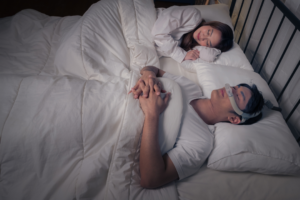
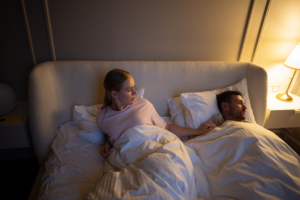
You put on the mask, turn off the light, and then lie there wide awake. If you can’t sleep with CPAP, the problem often starts well before the mask goes on.
The hours before bed shape how easily your brain lets go at night. Good sleep routines can turn CPAP into part of settling down instead of one more hurdle.
Many people who can’t sleep with CPAP blame the machine first. They try a new mask, a new pressure setting, or a new pillow, and still find themselves reaching for their phone at 1 a.m.
That frustration is understandable, and you are far from alone. Research on CPAP adherence has found that roughly half or more of adults with sleep apnea don’t use CPAP enough to get its full benefit, and many give up within the first year.
CPAP asks your brain to relax while something unfamiliar sits on your face. That is much harder when your evening has kept your mind switched on.
If this sounds like your nights, the Adapting to CPAP® program was created to help people relax with the mask, one step at a time. See how the program works.
What a new study on phones and sleep found
A May 2026 study in JAMA Pediatrics tracked real phone activity in 657 teens. On school nights, they averaged about 50 minutes on their phones between 10 p.m. and 6 a.m., with most of that time spent on social media.
More than half of the teens used their phones at least once between midnight and 4 a.m. Lead author Dr. Jason Nagata of UC San Francisco explained that when messages appear overnight, “that can reactivate them and make it harder to fall asleep.”
Sleep researcher Dr. Mary Carskadon of Brown University, who was not involved in the study, described why these apps are so disruptive. “When you’re supposed to be sleeping, your arousal levels need to go down, but those are the kinds of interactions that amp up your arousal and make it harder to sleep,” she told CNN.
The same concepts apply to adults
This research focused on teenagers, and the same concepts apply to adults. I often talk with my adult CPAP patients about these exact habits, because a stimulated, alert brain is the last thing you want when you are learning to sleep with a mask.
The researchers also found that one of the top predictors of a teen’s screen use was their parents’ screen use. Grown-ups feel the same pull of the phone at night, and the same changes help.
I’ll admit, I often smile at my patients and say, “Do as I say, not as I do.” I’m human, and I sometimes give in to late-night doom-scrolling too.
And on the nights I put the phone away, my sleep and my energy the next day are much better.
Why you can’t sleep with CPAP when your brain is still switched on
Falling asleep is a shift from alert to calm. Your body looks for signals that the day is over, such as dimmer light, slower thoughts, and a feeling of safety.
CPAP adds a new sensation right at that moment. If your mind is still buzzing from email, news, or scrolling, the mask can feel like one more thing demanding your attention.
That is when many people start noticing the air pressure and the straps. Many individuals pull the mask off or give up for the night, which can make the next night feel harder too.
This pattern has a lot to do with how the mind and body react together. You can learn more in our post on CPAP psychology and the mind-body connection.
Sleep habits that support CPAP use
Good sleep routines are skills, and they work best when they are simple and repeatable. These are the habits I review most often with adults who can’t sleep with CPAP and want a better nightly routine.
Give your phone a bedtime
Aim to put screens away 30 to 60 minutes before bed, which matches guidance from the American Academy of Sleep Medicine. If you can, charge your phone outside the bedroom and use a simple alarm clock instead.
If the phone needs to stay nearby, turn on “Do not disturb” and place it face down across the room. Fewer overnight alerts mean fewer chances for your brain to jump back into alert mode.
Keep a steady sleep schedule
Going to bed and waking up at about the same time every day, weekends included, helps set your internal clock. A consistent schedule also makes the CPAP habit easier to build, since the mask goes on at the same point every night.
Build a wind-down routine
Choose two or three calming activities for the last half hour of your evening. Reading a paper book, a warm shower, gentle stretching, or quiet music all work well.
Keep the order the same each night. Over time, your brain learns that this sequence means sleep is on its way.
Make the mask part of the routine
Many people treat CPAP as a hurdle at the very end of the night. Try making it one of the calm steps in your routine instead.
For example, put the mask on and turn the machine on while you read for ten minutes. Your brain begins to connect the mask with relaxing, which is exactly the link you want.
Set up your bedroom for rest
A cool, dark, quiet room makes it easier for your body to settle. Place your CPAP machine where the hose reaches comfortably, and keep your equipment clean so it feels fresh and inviting.
Pay attention to caffeine, alcohol, and late meals
Caffeine can stay in your system for hours, so try to stop by early afternoon. Alcohol may make you drowsy at first, and it tends to break up sleep later in the night.
A heavy meal close to bedtime can also make lying down less comfortable. A lighter evening snack is usually easier on your sleep.
If you’d like guided practice for feeling calm with the mask itself, Adapting to CPAP walks you through it at home, at your own pace. Explore the program.
What to do when you still can’t sleep with CPAP
Some nights you will do everything right and still lie awake. That is understandable, and it does not mean CPAP won’t work for you.
If you have been awake for about 20 minutes, get up and do something quiet in dim light until you feel sleepy. Lying in bed frustrated can teach your brain to link the bed, and the mask, with struggle.
If you took the mask off, put it back on when you return to bed. Every hour counts for your health, and it also counts toward the usage many insurance plans track, as explained in our guide to CPAP insurance requirements.
If you can’t sleep with CPAP, calm your body first
Slow belly breathing is one of the simplest tools you can use. Rest one hand on your belly, breathe in gently through your nose, and feel your hand rise as your belly fills with air.
Then let the breath out slowly through your mouth, a little longer than the breath in, and feel your hand fall. Repeat for a few minutes, first without the mask, then with the mask on and the machine running.
Medical hypnosis builds on this kind of focused relaxation. It helps change how your body responds to the mask, so the feeling of air pressure becomes calm and familiar.
If the mask brings on a closed-in or panicky feeling, our post on overcoming CPAP claustrophobia and anxiety goes deeper.
How medical hypnosis and CBT help CPAP become a habit
Better sleep habits make CPAP easier, and some people need more support with the mask itself. That is where medical hypnosis and cognitive behavioral therapy (CBT) come in.
Hypnosis helps quiet the body’s alarm response to the mask. CBT helps you notice and change thoughts like “I’ll never get used to this,” which can keep you tense at bedtime.
These are skills you learn and keep. Many people who once struggled now describe CPAP as simply part of going to sleep, as you can read in these stories from program users.
Small changes add up
If you can’t sleep with CPAP right now, you don’t have to change your whole evening tonight. Pick one habit, such as charging your phone outside the bedroom, and practice it for a week.
Each calm night makes the next one a little easier. With steady routines and the right tools, CPAP can become a comfortable part of how you rest.
When you’re ready for more support, the Adapting to CPAP program teaches medical hypnosis and CBT skills you can practice from home. Get started with Adapting to CPAP.
You can also schedule a telemedicine visit with me at jefflazarusmd.com/contact.
About Dr. Jeffrey Lazarus, MD, FAAP
Dr. Lazarus is a board-certified physician who completed his medical training at Stanford University Medical Center. He is an Approved Consultant with the American Society of Clinical Hypnosis and a Level 3 Advanced TEAM-CBT Therapist through the Feeling Good Institute.
With over 25 years specializing in medical hypnosis and cognitive behavioral therapy, Dr. Lazarus has helped hundreds of patients overcome challenging health conditions through evidence-based visualization and self-hypnosis techniques.
Dr. Lazarus practices in Menlo Park, California, and works with patients nationwide via telemedicine. To schedule a consultation, visit https://jefflazarusmd.com/contact/.